The System's Collapse on Gogri
Systema Delenda EstThe System's Collapse on Gogri is both a liberation and a planetary catastrophe. The System’s connection to the world fails only days after Cato arrives, leaving him unopposed, but its brief presence has already shattered civilizations, replaced native ecosystems, unleashed monsters, and destroyed the infrastructure on which hundreds of cultures depend. The collapse removes the occupying power without restoring the world it damaged; instead, it makes Cato responsible for rebuilding a society that sees his alien machines as another apocalypse.
Causes and Background
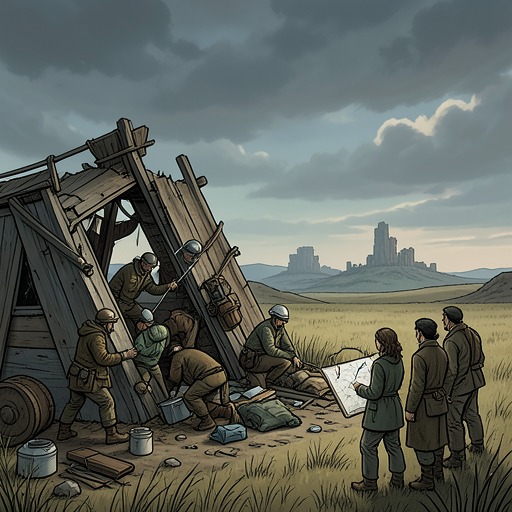
The world Cato refuses to call Gogri is caught in its age of sail when the System arrives. Hundreds of distinct cultural and genetic groups occupy four major continents and several large archipelagos, with seafaring states, foundries, roads, mines, and cities concentrated especially on the cooler southern continent. The invasion does not merely impose new rules on existing institutions. It replaces fertile terrain, introduces hostile beasts, smashes ships, collapses mines, and causes foundries to crumble. The result is a worldwide breakdown in which hunter-gatherers lack the population needed to resist monsters while maritime civilizations lose the supply chains that keep their cities alive.
The disaster is made more acute by timing. The southern civilizations have only a few weeks of food stores in many regions, and the coming winter threatens to become their last. Some populations can no longer forage or hunt because the System has replaced the local plants and animals. The world therefore reaches the point of collapse before Cato’s intervention begins: its peoples are not simply subjects awaiting liberation, but survivors already facing famine, infrastructural failure, ecological displacement, and predation.
The Collapse of System Rule
Unlike the prolonged crises on other worlds, the System’s incursion on Gogri is brief. Mere days after Cato passes through the portal, the connection collapses. Whether the System is severed before it can establish itself fully or whether any world loses the System when isolated from the wider network remains uncertain, but the practical result is decisive: Cato faces no organized opposition from the System while attempting to stabilize the planet.
The disappearance of System support is not a gentle return to an earlier natural order. Elsewhere, the removal of the System causes lights and stores to lose power, mountains to crumble or vanish, lakes to become muddy plains, storms to appear and dissipate unpredictably, and alien forests to wither while native biology struggles to return. On Gogri, the same underlying reversal is folded into a social emergency. The world is freed from the regime that transformed it, but the inhabitants inherit the wreckage of that transformation rather than the world that existed before it.
The event also contrasts with the System’s arrival on Earth, where technology failed, monsters appeared, and billions died as humanity was forced into the System’s game-like physics. On Gogri, the catastrophe exposes the same pattern across a different species of civilization: technological and ecological systems that seemed local become inseparable once the System rewrites the planet. Its collapse therefore reveals the System not as a neutral framework that can simply be switched off, but as an infrastructure whose withdrawal is itself destructive.
Cato’s Emergency Response
With no System power left to oppose him, Cato uses the full meaning of his postbiological technology. He deploys massive biomechanical production facilities across broad areas of dead and dying vegetation and animals, treating the devastation as a problem of biomass, manufacturing, and exponential growth. The orbital version of Cato works in parallel on the local moon, while aircraft spread biomass seeds over likely regions to accelerate recovery.
The response is carefully calculated but dangerously narrow. Modeling indicates that Cato can barely produce enough food to prevent the worst starvation, and that success depends on cooperation from the inhabitants. His machines can fabricate biomass, shelter, and the beginnings of a replacement ecological system, but they cannot automatically create trust, social consent, or functioning political authority. The rescue effort thus shifts the central problem from defeating the System to persuading survivors that alien intervention is preferable to continued collapse.
Cato and the Talis sisters approach the remains of the largest civilization’s palace in aircraft, with Raine Talis and Leese Talis retaining their original bodies but augmenting themselves until they resemble warframes. They make no effort to disguise the nature of their capabilities, even though those capabilities are closer to those of a main battle tank than to anything the local societies possess. Leese is uneasy about the role, while Raine points out that Cato, rather than the sisters, must do the talking. The moment captures the political limit of technical salvation: Cato can seed a continent with the means of survival, but only direct negotiation can turn those means into a future.
Consequences and Aftermath
The collapse leaves Gogri’s societies in an absolute worldwide crisis. Ships have been destroyed by sea monsters, cities have become death traps, mines and foundries have failed, and the disruption of farming has removed the material basis of both settled life and long-distance exchange. The destruction is distributed across species, cultures, and continents rather than confined to one defeated capital. No civilization escapes untouched, and Cato begins with almost no orbital infrastructure or observational capacity, relying initially on the warframes sent through the portal.
The ecological consequences extend beyond hunger. System-transplanted organisms die in enormous numbers, while the native world lacks the bacteria needed to break down the alien biomass and recycle its remains. The collapse therefore threatens both food production and the basic cycles on which breathable air and usable soil depend. Cato’s intervention is an attempt to replace missing planetary functions before famine and ecological stagnation become irreversible, but the scale of the work makes every success provisional.
The event also establishes a recurring pattern in Cato’s campaign. Destroying the System is only the first half of liberation. Once the System disappears, ordinary physics, native biology, agriculture, oceans, atmosphere, infrastructure, and social trust become urgent political responsibilities. Cato’s victory on Gogri is consequently less a conquest than an involuntary trusteeship: he removes the power that caused the catastrophe, then must persuade its victims to accept the machinery of recovery from the outsider who arrives immediately afterward.
Narrative Significance
The System's Collapse on Gogri gives concrete form to the book’s central distinction between liberation and restoration. Cato succeeds militarily because the System falls before it can consolidate its hold, yet that success produces no uncomplicated triumph. The people remain alive, but their civilization has been stripped of ships, food networks, industry, and ecological continuity. Freedom arrives as a devastated landscape that must be made habitable again.
The event also makes Cato’s resemblance to the System ethically unavoidable. His biomechanical factories, aircraft, and seeded biomass are tools of rescue, but they are vast, alien, and capable of remaking the planet at hegemonic scale. The difference between him and the System cannot rest on technological appearance alone. It must be demonstrated through what his machinery is used for, whether the inhabitants retain meaningful agency, and whether reconstruction can become cooperation rather than another imposed order. Gogri therefore turns the System’s collapse into a test of post-System politics: ending domination is necessary, but the survivors must still be given a world in which they can choose what comes next.